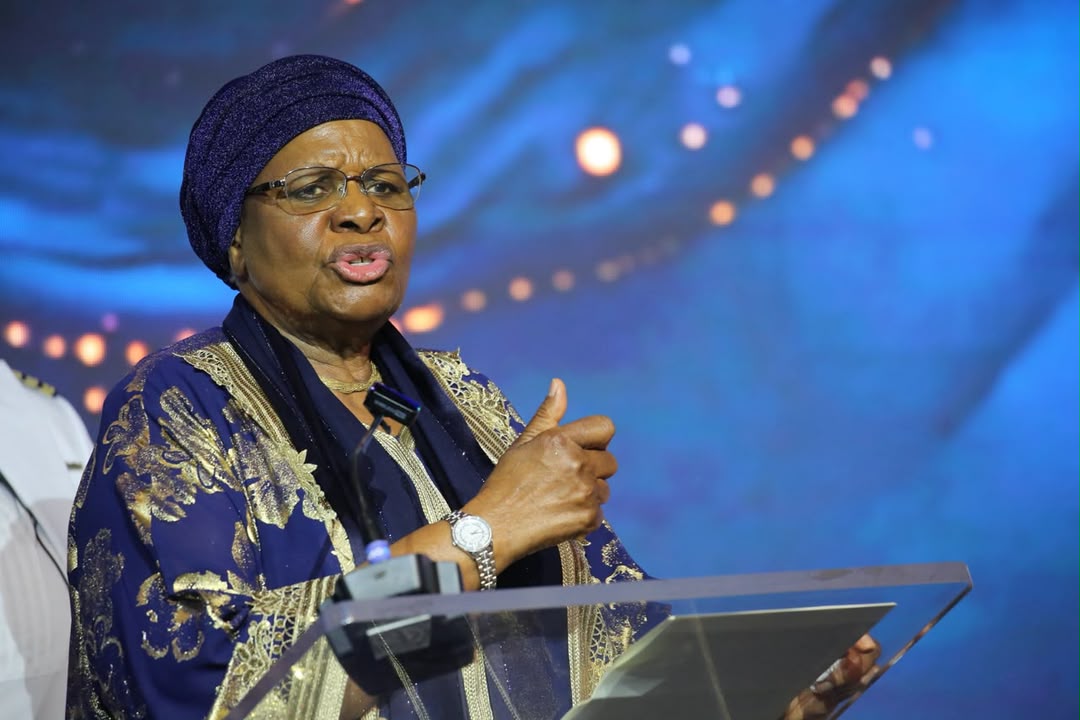
National Assembly on 30 September 2026.
Contribution by Professor Job Shipululo Amupanda to the Petroleum (Exploration and Production) Amendment Bill, 2025.
People of Namibia and Honourable Members,
When closely considered, the debate on this Bill takes us to the theoretical framing of cognitive dissonance. Simply put, cognitive dissonance is the discomfort one experiences when thoughts, beliefs and actions do not match. The similarity lies here: when the key assumptions of the Bill were challenged, a coordinated and uncritical defence was mounted—a defence which, in final analysis, is even far from the actual text of the Bill itself. Indeed, the actions contained in the Bill and the mounted defence are miles apart, like the knowledge gap between honorary doctorate holders and real doctorate holders.
The Bill does not become what its defenders claim it is through attempted clay plastering. Its actual text remains as it is, no matter the amount of viva defence. Honourable Tshitumbe tshaAmutse, the portfolio minister, in his tabling of the Bill, only speaks to six things: (1) the establishment of the Upstream Petroleum Unit; (2) streamlined technical oversight and regulatory clarity; (3) transparency and parliamentary reporting; (4) ethical conduct and disclosure of interests; (5) modernisation of the legal framework; and (6) transitional and continuity provisions. In the hierarchy of importance and consideration, the Minister’s stated intentions are second only to the Bill itself.
Let us demonstrate how the actual content of the Bill reveals a far more troubling reality.
THE ACTUAL CONTENT OF THE BILL
An informed and careful reading of the Bill would reveal that it actually serves one purpose and one purpose only: power configuration and its institutional anchors. It is about removing powers from one functionary to another functionary.
Firstly, the Bill removes powers from the Minister to the President. Clause 1(a) of the Bill substitutes the expression “Minister” with “President” wherever it appears in sections 63(1), 64, 65, 76A and 77 of the principal Act. This transfers substantial powers from a Minister accountable to Parliament to the President.
Secondly, the Bill transfers other powers from the Minister to another person working for the President, the Director-General. Clause 1(b) substitutes the expression “Minister” with “Director-General” in no fewer than seventy provisions of the principal Act.
Thirdly, the Bill transfers powers from the Petroleum Commissioner to another person working for the President, the Deputy Director-General. Clause 1(c) substitutes the expression “Commissioner” with “Deputy Director-General” wherever it appears in the principal Act.
To support this power grab, the Bill then creates an Upstream Petroleum Unit, again under the President, and provides for the appointment of its functionaries, again by the President.
In summary, the Bill gives power to the President and her two political appointees under her wings and creates an institution under her office. This power is taken from professionals appointed through transparent public processes and given to functionaries appointed by a politician. It also removes powers from a functionary whom the Constitution saw fit to be a member of Parliament—accountable to Parliament—and transfers those powers to individuals who are not accountable to Parliament.
WHAT THE BILL IGNORES
It must be remembered that this Bill amends 36-year-old legislation, the Petroleum (Exploration and Production) Act, 1991 (Act No. 2 of 1991). Minister Tshitumbe tshaAmutse states the following: “This Bill is forward-looking. It reflects the maturity of our governance institutions and our readiness to responsibly manage the opportunities that petroleum development brings.”
This is a strange proposition. If anything, it reflects regression, not maturity of our governance institutions. Let us demonstrate why this is the case.
Firstly, Africa loses N$720 billion annually. The old 1991 Petroleum Act, in section 62, still has a 12.5% royalty payable. Yes, a fixed percentage in the Act. This is fixed in the law and has never changed. This Bill does not seek to change it.
Section 63 also grants powers to the Minister to allow and excuse mining companies from paying tax. This has not been changed and it remains in force. This Bill does not change this. It now simply transfers these very powers to the President, who only accounts to Parliament once a year.
In a multibillion-dollar sector, the old Act still has a fine not exceeding N$100,000. The message is: fail to pay tax, the fine is only N$100,000 and less.
How can an amendment that ignores these material aspects be seen as forward-looking and reflecting the maturity of our governance institutions? We must, therefore, see this Bill for what it is—a power configuration exercise that has nothing to do with, nor is it interested in, solving the problems contained in the 36-year-old Petroleum (Exploration and Production) Act of 1991.
THE DANGERS OF THE BILL
The problem of this Bill does not necessarily lie in the fact that it ignores important challenges with the existing legislation. Its danger can be located at three levels: Constitutionalism, State Craft, and the political culture of short-termism.
First: Constitutionalism
The Bill offends the Namibian Constitution in many respects.
Article 35(1) of the Namibian Constitution provides that the President shall appoint as Prime Minister and Ministers members of the National Assembly. Article 37 provides that the President may appoint as Deputy Ministers members of the National Assembly. These provisions make it impossible for anyone to be a substantive member of Cabinet if they are not members of Parliament. The Constitution specifically sets out that Ministers shall be accountable to Parliament individually and collectively.
The principle of legality is not just a principle that our judiciary has elucidated in its judgments. It is contained in the first Article of our Constitution—Article 1(1)—which declares that Namibia is a Republic based on the Rule of Law. Article 1(6) provides that the Constitution is the supreme law of Namibia.
In 1990, this Parliament passed the Assignment of Powers Act, 1990 (Act No. 4 of 1990). While section 3 of this Act permits the President to assign the administration of any provisions in any law, such can only be assigned to the Prime Minister or a Minister. The lawmaker was aware that executive power must at all times be subject to oversight by the legislature.
In its current form, the Bill offends these constitutional provisions, and it is a good candidate for a declaration of unconstitutionality. Parliament is being asked to pass a law that will introduce the very disease the Constitution sought to avoid.
Minister Amutse states the following about parliamentary oversight: the Bill “requires that all remissions, deferrals, or refunds of petroleum royalties be reported annually to the National Assembly by 30 June, through a designated minister or the Prime Minister. This provision ensures that Parliament remains fully informed about the management of petroleum revenues and that the executive branch remains accountable for every concession granted under the law.”
It would seem that the Minister and those pushing the law are of the view that parliamentary accountability and oversight is limited to a 30 June Excel sheet of royalties and revenue. This is an argument that even a judicial officer at a Community Court can easily dismiss. Our constitutional scheme did not envisage Parliamentarians waiting for June to do their work on an important sector such as petroleum. If that was the case, the Constitution would have made provision for something like that, as it did in the case of the President and the State of the Nation Address under Article 32.
Moreover, the Bill’s transfer of powers to the President under section 3(2)(a), allowing the President to delegate powers under sections 63(1), 64 and 65 to the Vice-President, the Prime Minister, a Minister or the Director-General, further compounds this constitutional crisis. The President is also prohibited under section 3(2)(b) from delegating powers under sections 76A and 77, which relate to regulations and amendment of Schedule 1, respectively. This creates a constitutional anomaly where the President retains unfettered regulatory power while the Minister, who is accountable to Parliament, is bypassed entirely.
Second: State Craft
Simply explained, State Craft refers to the skillset and sophistication necessary for conducting state affairs and the management of public institutions, including political and governance structures. What this Bill seeks to do is a classic demonstration that those in charge of our state either do not have the skillset or are incapable of State Craft.
The NIPDB was brought under the wings of the previous President for direct control, just for the current President to dismantle it and send it back to the Ministry of Trade. The previous President used the same arguments being advanced today. To his credit, the previous President was sophisticated and did not seek to change the laws that gave him and people under him powers. This current President is doing exactly the same but going a step further by violating the Constitution.
Another concern is this: if there is corruption at the Ministry responsible for energy, what about other departments and ministries where corruption is worse? How about the diamonds, gold, roads and public infrastructure? The President has three years left. What would happen in three years with the new President?
An understanding of State Craft would suggest clearly that having a kitchen in your bedroom is a recipe for obesity.
Third: Political Culture of Short-Termism
Coupled with these constitutional and State Craft concerns is the growing perception that these illogical measures are being done to benefit the family of the President, who have been widely reported as having business interests in the oil and gas sector. Imagine if this political culture of short-termism, underpinned by kinship economic interest, is allowed to continue permeating into lawmaking with each President and Ministers alike!
God help us! What this short-termist political culture does not realise is that it has effectively delivered the President at the doorsteps of countless litigation as an administrative official.
ARE THERE POSSIBLE EXIT ROUTES?
We had welcomed the appointment of the Minister in the Presidency. As we informed the President during the SONA, this appointment presents an opportunity for curing the problems the Bill currently presents. This is because we at least have someone in Parliament to whom we can direct our concerns as part of discharging our constitutional duties.
The challenge, however, is that this Act does not refer to the Minister in the Presidency. It mentions the President, Director-General and Deputy Director-General of the Upstream Unit and their subordinates. If the powers given to the President can be changed to the Minister in the Presidency, then the Ministerial Accountability question could be answered.
Apart from the route we had submitted and presented to the President herself at State House, another alternative could be a comprehensive review and overhaul of the whole Petroleum (Exploration and Production) Act so that a new Act can be drawn up in the same way the Land Bill was handled.
But judging from the triumphalism and parochial chest-beating approaches we are subjected to, singing and bulldozing will be the order of the day, and with the purchase of the few, it will be bulldozed. In that case, as we have already prepared and we can announce, we will meet at a place where it will be announced, “All Rise,” as the men and women of the gowns emerge to take their seats in the chambers that will restore constitutionalism.
CONCLUSION
There is a reason why the 72,227 Namibians voted for the revolutionary force of the left to be in this Parliament, and for that we will remain true. Robert Mangaliso Sobukwe told the Africans, while under harassment and banishment: “take into Africa a vision of Africa reborn … an Africa that will not relent, equivocate, or compromise.”
We are here to take into Namibia a vision of Namibia reborn, a Namibia that will not relent, equivocate and compromise. This Bill, in its current form and without the suggested changes, cannot be supported.
I thank you, Honourable Members and the People of Namibia.