






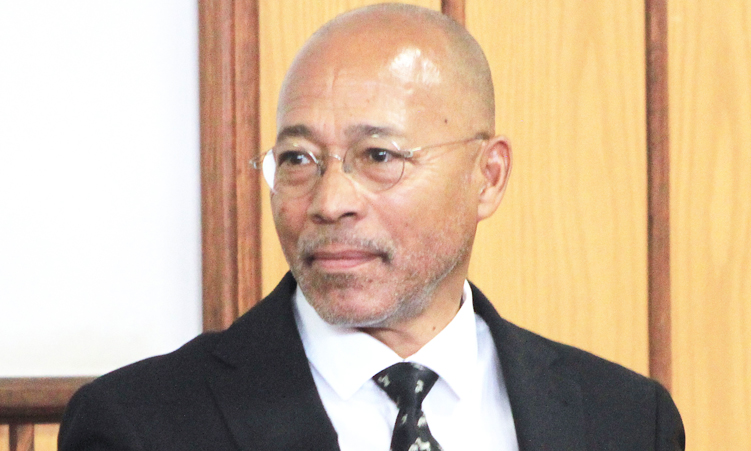
Veteran lawyer Dirk Conradie abused his position as chairperson of the board of directors of the company Mobile Telecommunications Limited (MTC) when he tried to use the promise of a multimillion-dollar MTC contract to persuade the owners of an advertising company to take a friend of his on as a black economic empowerment partner in their business.
High Court judge Thomas Masuku said this before sentencing Conradie on two charges under the Anti-Corruption Act at the end of a drawn-out trial yesterday.
“It is clear he was nepotistic in his conduct,” Masuku remarked, before sentencing Conradie (67) to pay a fine of N$200 000 or serve a prison term of five years.
Masuku sentenced Conradie’s co-accused and family friend, Sara Damases (62), to pay a fine of N$60 000 or serve a two-year prison term.
Conradie and Damases were both found guilty on counts of corruptly soliciting gratification as a reward for using influence in procuring a contract, and attempting or conspiring to contravene sections of the Anti-Corruption Act in February this year.
Masuku found that Conradie solicited gratification from the directors of an advertising company, DV8 Saatchi & Saatchi, during a meeting at the offices of his law firm, Conradie & Damaseb, in Windhoek in June 2012.
Conradie did so by asking the advertising company’s directors to agree to take Damases on board in their business as a black economic empowerment partner or in any other role, while promising that in return he would use his influence with the board of directors of MTC, of which he was the chairperson, to ensure an advertising contract worth about N$60 million would be awarded to DV8.
The directors of DV8 reported Conradie’s offer to the Anti-Corruption Commission, and the MTC board decided to award the advertising contract in question to another company.
As a legal practitioner and officer of the court, Conradie is in an exalted position in society, Masuku said during the sentencing.
The fact that he is a legal practitioner played a critical role in Conradie’s appointment on various boards, Masuku added, before saying he had come to a conclusion that Conradie abused his position.
“I am acutely aware that he did not personally benefit from the crime he committed and that he was not the ultimate beneficiary in the event everything went according to plan,” Masuku said.
“This does not, however, ameliorate the seriousness of the offences of which he has been convicted. It is clear that he was nepotistic in his conduct,” Masuku commented.
He also said Conradie was highly regarded in society, and “stands to lose honour and respect”.
“Probably the one thing that matters most to him, namely, the status as an officer of this court, for which he has worked his entire life, stands in serious jeopardy,” Masuku remarked.
He continued: “That, however, has been down to choices that he deliberately made and with a full presence of mind. His professional training and status ought to have made him particularly conscious of the criminality and impropriety of his conduct.”
Masuku further said: “His actions represent not merely a breach of the law, but a profound betrayal of the standards expected of one who has undertaken, as a legal practitioner, to uphold the law.”
On the crime of corruption, Masuku quoted from a South African Constitutional Court judgement: “The seriousness of the offence of corruption cannot be over-emphasised. It offends against the rule of law and the principles of good governance. It lowers the moral tone of a nation and negatively affects development and the promotion of human rights. Corruption threatens our constitutional order. We must make every effort to ensure that corruption with its putrefying effects is halted.”
Conradie and Damases denied guilt on the charges when their trial started in March 2016. The first testimony in the trial was heard only in May 2018.
Senior counsel Vas Soni and Slysken Makondo represented Conradie during the trial.
Damases was represented by Vetu Uanivi.
Deputy prosecutor general Ed Marondedze represented the state.