






Namibian businessman Knowledge Katti’s Namibia Marine Phosphate has received the greenlight for its controversial Sandpiper marine phosphate mining project, with political parties and conservationists raising concerns over the decision.
The environmental commissioner in the Ministry of Environment and Tourism issued an environmental clearance certificate (ECC) on 5 August, which will be valid until 5 August 2029.
It covers the proposed Sandpiper marine phosphate project within mining licence 170 (ML 170) offshore Namibia.
Ministry spokesperson Vilho Hangula has confirmed the authenticity of the certificate.
“The ECC is authentic, and further communication on this shall be provided in due course,” Hangula said last week.
The Namibian has reached out to Katti, who is a shareholder in Namibia Marine Phosphate (NMP), for comment, but was unsuccessful at the time of going to print.
The development brings the long-running Sandpiper project closer to implementation after years of environmental concerns, opposition from sections of the fishing industry, and legal challenges.
CALLS FOR SUSPENSION
The Independent Patriots for Change (IPC) has called for the ECC to be suspended pending an independent review.
IPC shadow minister of environment and tourism Rodrick Likando says the decision “revives one of the most contested industrial proposals in Namibia’s post-independence history”.
“The Sandpiper project has no comparable precedent anywhere in the world,” he says.
The IPC has questioned whether the scientific information used to support the latest clearance were sufficiently updated.
The party has also questioned whether public consultation dating back to 2022 could be regarded as current for a certificate issued in August 2026.
“Given that public consultation on this iteration of Sandpiper dates back to 2022, the IPC questions whether that record can be properly treated as current for a clearance issued in August 2026,” Likando says.
The IPC is calling on the ministry to make the environmental impact assessment, the public participation record, and the scientific basis for the decision public.
Likando says the party would table parliamentary questions on the matter when the National Assembly resumes on 1 September.
‘RELEASE REPORT’
Popular Democratic Movement leader McHenry Venaani says his party is calling for the environmental report to be made public so that its findings can be independently scrutinised.
He says he has previously raised questions in the parliament about the report, and has asked the environment minister for the report to be released.
“It’s one thing to clear and to give a clearance report. It’s another thing to make the report public,” Venaani says.
He says Namibia needs to consider the potential economic benefits, including employment creation, while seriously considering the scientific consequences of the project.
“We have a very large coastline of over 1 800km with a high youth unemployment rate in the country. So, each and every business opportunity that can create jobs must be looked at clinically – also bearing in mind the scientific consequences of such a clearance,” he says.
Venaani says the debate should be based on scientific evidence, rather than automatically rejecting the project.
“But this thing of Namibians just blocking our heads and saying, no, phosphate mining is bad for our country, therefore, we don’t have it – it’s not reasonable,” he says.
He calls for the report to be made available to scientific bodies and other experts for independent scrutiny.
“Our position is very clear that the report must be made public,” Venaani says.
Swapo deputy secretary general Uahekua Herunga says he has no objections to the clearance certificate if NMP has met all the legal requirements.
He says his comments are not the party’s official position, adding that would require a decision by the party’s political bureau or central committee.
“If the environmental clearance certificate was issued by the relevant ministry . . . it means that particular entity has met all the necessary requirements according to the law of Namibia,” Herunga says.
He asks why the certificate should be suspended if the requirements had been met.
Herunga says an investigation could be conducted without suspending the certificate.
“If they want transparency, they must just go further, they must call for investigation, but not for suspension,” he says.
‘BAD NEWS’ FOR CONSERVATION
Ocean Conservation Namibia has also criticised the issuance of the ECC.
In a Facebook post, the organisation describes it as a “huge development” and says the clearance is bad news for Namibia, the Benguela ecosystem, the fishing industry, and marine conservation.
The organisation says Namibia will be the only country in the world to allow marine phosphate mining and warns about “unpredictable environmental outcomes”.
“We cannot allow Namibia to become a global guinea pig!” the organisation says.
The Sandpiper project has been at the centre of debate over marine phosphate mining in Namibia for more than a decade.
In 2013, the Cabinet imposed a moratorium on marine phosphate mining to allow scientific studies on the possible environmental consequences of seabed dredging.
NMP later pursued environmental approval for the Sandpiper project and has maintained that phosphate mining can coexist with the fishing industry.
In 2022, the company announced that it had completed its final environmental and social impact assessment following consultations with interested and affected parties.
NMP says the assessment included 28 specialist studies and considered scientific information relating to the Benguela Current Large Marine Ecosystem and Namibia’s commercial fisheries.
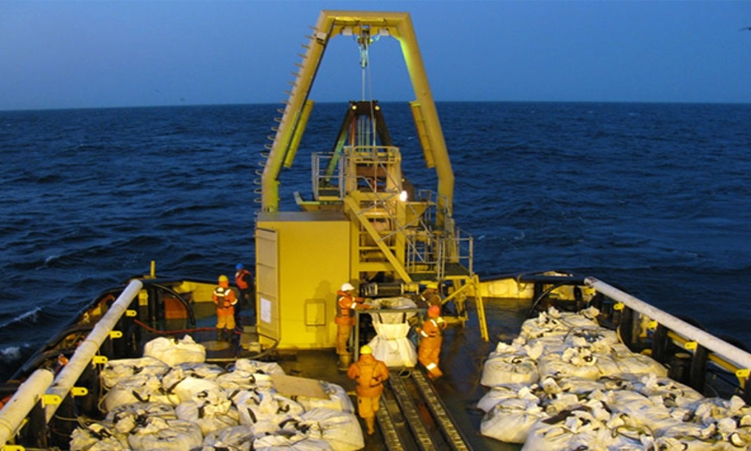
The company has previously said the proposed project would have a lifespan of about 20 years and cover approximately 34 square kilometres, with an average annual mining area of about 1.7 square kilometres.
NMP has also argued that the proposed mining operation can coexist with fishing because of the relatively small area that would be mined compared with the wider fishing grounds.
Confederation of Namibian Fishing Associations chairperson Matti Amukwa could last week not be reached for comment, however, the confederation has historically opposed marine phosphate mining in Namibian waters, arguing that Namibia’s valuable fishing industry cannot be used as a “case study”.