




ENVIRONMENT minister Pohamba Shifeta says the law prohibits the exporting of unprocessed or semi-processed Namibian timber, unless it is for research or educational purposes.
Shifeta made these remarks to on Monday this week when asked about the interpretation of the Forest Act, 2001, which aimed to protect rare Namibian trees from being exported.
The minister said unprocessed Namibian wood was not supposed to cross the borders in the first place.
Shifeta referred to the Forest Act, 2001, which states that “a person may not export any unprocessed forest produce, including semi-processed planks, unless authorised by the director for special purposes such as research, education, cultural and disease identification, for which relevant documents are to be provided as a prerequisite”.
That regulation falls under a subsection that deals with the “harvesting, transportation, processing, sale, importation, transit, and exportation of forest produce and the issuing of permits, licences and other documents required for those activities”.
Most of the timber that exported from Namibia are semi-processed planks, the forestry ministry confirmed.
To Shifeta, ignoring that law is further proof that timber traders and state officials have broken yet another law meant to protect Namibia’s rare trees.
“It was completely illegal, not only in terms of the Environmental Management Act No 7 of 2007 that they did not have environmental clearance certificates, but also in terms of the Forestry Act No 12 of 2002 and its regulations,” stated the minister.
The same Forestry Act says the director could not have allowed the commercial harvesting of timber without an Environmental Impact Assessment, Shifeta said.
“I still strongly feel that those officials who permitted these activities must be charged for administrative misconduct, and investigation must be done for possible criminal charges,” he continued.
Shifeta’s comments open a Pandora’s box on why the government allowed the exporting of Namibia’s rare trees, which is banned by law.
The environment ministry believes that any concerned Namibian citizen can sue the government to block the exporting of timber since it is unlawful.
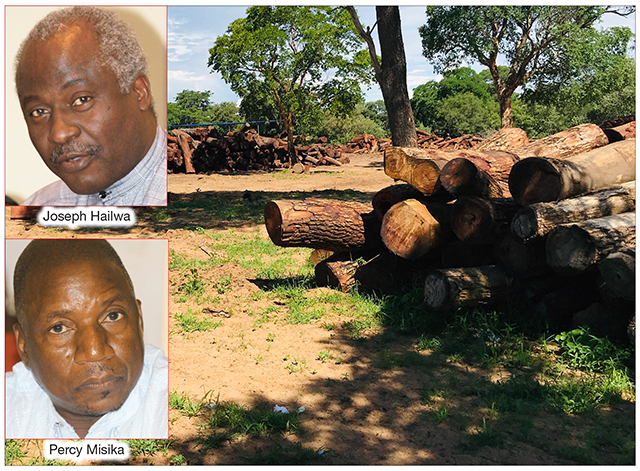
The executive director of the agriculture ministry, Percy Misika, admitted to yesterday that “there has been an omission” in following the law, which is why the government banned the transportation and harvesting of timber to correct the “mistakes” made.
According to him, the director referred to in the Forestry Act is currently Joseph Hailwa, the head of the forestry department, which is tasked with protecting Namibia’s forests and implementing the Forest Act.
“Those questions [why the law was ignored] should be checked with the competent authority [Hailwa]. He should be able to answer how he made his decisions,” Misika said.
The executive director, however, admitted that a lot of mistakes were made, which led to the harvesting and transportation ban in November last year.
“There were many omissions,” he said diplomatically.
Misika added that if unprocessed timber was exported, then it was illegal.
Forestry director Hailwa could be one of the top bosses facing criminal charges if Shifeta’s proposal to charge officials responsible for protecting the forests succeeds.
Hailwa, who reportedly served as the forestry department’s supremo for more than 15 years, appears unbothered by calls for him to face the chop.
Asked by yesterday whether he will resign for failing to protect Namibia’s forests as entrusted to him by the Constitution, Hailwa hesitated for two seconds, and said: “Uhmmm, I am not able to answer your questions”.
He added that the ministry allowed people to export raw timber because they wanted them to make an income.
However, the forestry regulations do not mention “income” as a reason to export unprocessed timber, but the director claims that it depends on how one interprets the law.
Hailwa admitted that most of the trucks on Namibian roads are seen transporting semi-proceed timber, which is illegal, but still practised. reported last month that exports of Namibian timber to China increased nearby tenfold – from 22 truckloads in 2015 to 208 truckloads in the first two months of this year.
In total, 3 200 tonnes of Namibian timber was exported to China in 2018. This figure has doubled to 7 500 tonnes during January and February alone this year.
This number could be higher if statistics of the timber which was exported in March this year is added, since it was the deadline month for transporting timber.
The applicants include parliamentarians, government officials, councillors, police bosses, as well as traditional and church leaders, who are among 230 individuals who since November 2018 have wanted to cut down rare rosewood trees on land spanning 570 000 hectares. This is more than the combined size of Windhoek and Okahandja.
– shinovene@namibian.com.na or Twitter: @Shinovene
In an age of information overload, Sunrise is The Namibian’s morning briefing, delivered at 6h00 from Monday to Friday. It offers a curated rundown of the most important stories from the past 24 hours – occasionally with a light, witty touch. It’s an essential way to stay informed. Subscribe and join our newsletter community.

The Namibian uses AI tools to assist with improved quality, accuracy and efficiency, while maintaining editorial oversight and journalistic integrity.
Stay informed with The Namibian – your source for credible journalism. Get in-depth reporting and opinions for
only N$85 a month. Invest in journalism, invest in democracy –
Subscribe Now!