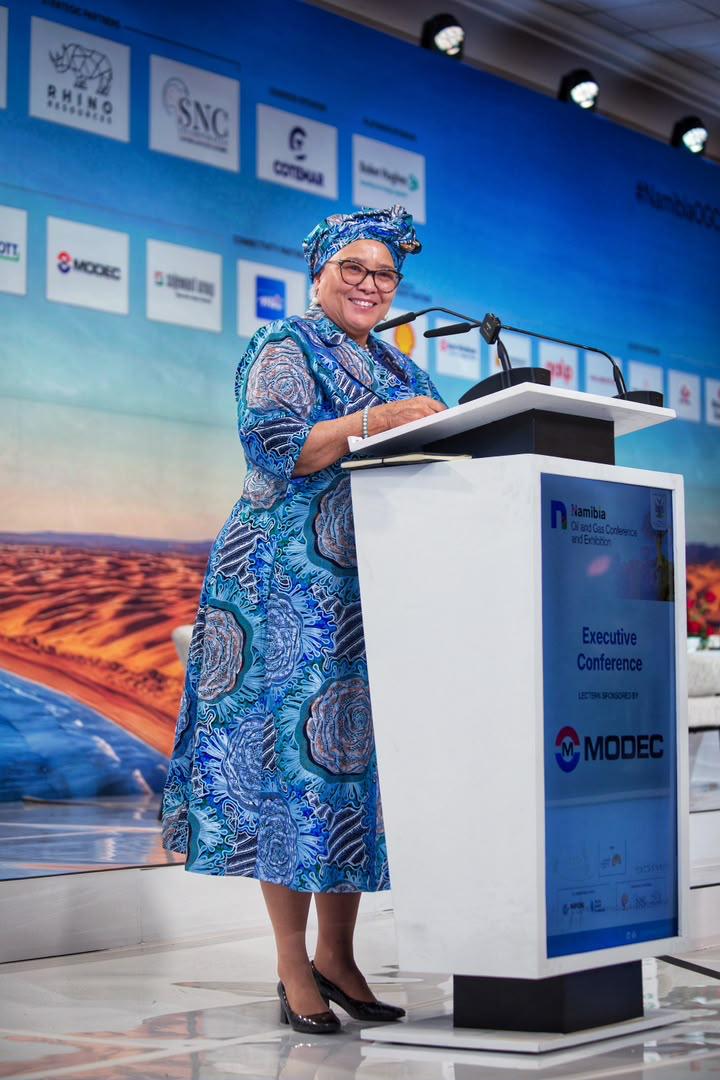
Windhoek, 19 August 2026 .
Statement by Her Excellency Lucia Witbooi, Vice President of the Republic of Namibia, on the Occasion of the Official Opening of the Namibia Oil and Gas Conference 2026, under the theme “From Decision to Dividend – Making Namibia’s Oil Work for Namibians”.
Director of Ceremonies;
Honourable Modestus Amutse, Minister of Industries, Mines and Energy;
Honourable Ministers and Deputy Ministers present;
Honourable Members of Parliament;
Honourable Kornelia Shilunga, Special Advisor and Head of the Upstream Petroleum Unit in the Office of the President;
His Excellency Dr. Philip Mshelbila, Secretary General of the Gas Exporting Countries Forum;
Honourable Sam Shafiishuna Nujoma, Governor of the Khomas Region;
Honourable Governors of other regions present here;
Your Worship Councillor Ndeshihafela Larandja, Mayor of the City of Windhoek;
Your Worships the Mayors of other local authorities present here;
Your Excellencies, Members of the Diplomatic Corps;
Mr. Jason Kasuto, Chairman of the Economic Association of Namibia and host of this Conference;
Mrs. Julia Muetudhana, Chief Executive Officer of the Namibia Investment Promotion and Development Board, and co-host;
Dr. Clemens von Doderer, Resident Representative of the Hanns Seidel Foundation Namibia, and co-host;
Mr. Shakwa Nyambe, Managing Partner of SNC Incorporated, co-organising partner;
Mr. Travis Smithard, Chief Executive Officer of Rhino Resources;
Ms. Victoria Sibeya, Managing Director of the National Petroleum Corporation of Namibia;
Captains of industry, esteemed investors, sponsors and exhibitors;
Distinguished speakers, panelists and delegates;
Members of the Media;
Ladies and Gentlemen.
Good morning.
It is my distinct honour to join you today on this important occasion marking the official opening of the Namibia Oil and Gas Conference under the theme: “From Decision to Dividend: Making Namibia’s Oil Work for Namibians”.
First and foremost, I bring you the warm greetings and full support of Her Excellency Dr. Netumbo Nandi-Ndaitwah, President of the Republic of Namibia, who is unable to join us today due to other equally important national duties. Her Excellency has delegated me to deliver this statement on her behalf, and the Head of State wishes this Conference a resounding success.
Allow me to commend the Economic Association of Namibia, in partnership with the Namibia Investment Promotion and Development Board and the Hanns Seidel Foundation, together with the strategic and co-organising partners Namibia Petroleum Corporation of Namibia (NAMCOR), Shakwa Nyambe and Company Incorporated (SNC) and Rhino Resources, for convening this important national platform. At this stage of Namibia’s petroleum journey, dialogue between Government, industry, investors, financiers, entrepreneurs, communities, academia and civil society is not a luxury. It is a necessity.
To our international guests who have travelled from across our continent and from across the oceans, I extend a warm welcome to Namibia, the Land of the Brave. You have come not simply as visitors, but as partners in a national undertaking whose consequences will extend well beyond the life of any single field or project. We trust that your engagement here will be characterised by candour, mutual respect, responsible investment and a shared commitment to creating lasting value.
Director of Ceremonies;
Namibia stands at a defining moment in its economic history. The petroleum discoveries made in the Orange Basin have transformed the country’s global energy profile and attracted some of the world’s leading energy companies and investors. Exploration and appraisal activity continue to expand our understanding of the basin, while major discoveries such as Venus and Mopane are moving the national conversation from exploration toward development and production. Recent exploration results in Shell’s PEL 0039, including the Merlin-1X well, have further demonstrated that the basin continues to hold significant geological potential. At the same time, the entry of new international partners into Namibia’s exploration portfolio demonstrates the continuing confidence in the country’s petroleum prospects.
But let me state clearly: discovery is not the destination. A resource beneath our waters becomes a national success only when it is responsibly developed and translated into tangible improvements in the lives of our people. It must become employment for Namibians, opportunities for our enterprises, skills for our young people, technology for our institutions, infrastructure for our economy, revenues for national development and savings for future generations.
This is why the theme of this Conference is particularly appropriate. The journey from decision to dividend is not merely a technical sequence from exploration to development and production. It is a national value-creation chain. Every decision taken today about field development, procurement, infrastructure, financing, technology, skills, taxation, environmental management and partnerships will determine the extent to which petroleum wealth is retained and multiplied within Namibia.
Our task is therefore to move from resource optimism to disciplined execution. Namibia must be ready for the transition from exploration to development. That means strengthening institutions, improving regulatory certainty, developing the necessary infrastructure and logistics, building a competitive domestic supplier base, preparing our workforce and ensuring that the State has the capacity to negotiate, monitor and manage increasingly complex petroleum operations.
The Government’s objective is not simply to attract capital into Namibia. We seek investment that creates enduring national value. We welcome international capital, technology and expertise because these are essential to developing complex deepwater resources. But partnership must be reciprocal. International investors must see Namibia not merely as a geological opportunity, but as a country in which they can build lasting industrial, human-capital and commercial partnerships.
The Government will continue to provide a stable and credible investment environment. Namibia’s political stability, constitutional democracy, independent judiciary and commitment to the rule of law remain important foundations for investment. At the same time, predictability must be matched by accountability. Government must be predictable in its rules and decisions, while investors must be predictable in their commitments, performance and conduct.
This is particularly important as Namibia approaches the first major development decisions. The Venus discovery is currently the most advanced offshore development project in the country. Publicly stated project plans have envisaged a development based on an FPSO, with a production plateau of approximately 150,000 barrels of oil equivalent per day and first oil around 2030, subject to final investment approval and completion of the required regulatory, fiscal, environmental and other processes. Mopane is progressing in parallel, with further exploration and appraisal planned to establish the resource base and development concept. These projects have the potential to establish the foundation of a new producing basin and, importantly, a new industrial ecosystem around it.
The Government therefore recognises that timely project delivery matters. At the same time, speed cannot come at the expense of sound governance, appropriate fiscal returns, environmental protection or long-term national interests. We must demonstrate that Namibia can be both investment-friendly and institutionally firm; both commercially competitive and protective of the public interest.
Ladies and Gentlemen;
Our Sixth National Development Plan, NDP6, places economic growth, transformation and resilience at the centre of Namibia’s development agenda. Within the oil and gas focus area, NDP6 envisages the development of an oil and gas industry that contributes to Namibia’s socio-economic development and sets 2030 outcomes for the emergence of domestic oil and gas production. It also identifies stronger legal and policy frameworks, sustainable field development, infrastructure and investment growth, and skills, research and innovation as important strategies.
The significance of this approach cannot be overstated.
Petroleum must not become an enclave industry operating alongside the Namibian economy. It must become a catalyst for diversification, industrialisation and enterprise development. The value chain must extend beyond the offshore platform to ports, logistics, fabrication, engineering, marine services, financial services, information technology, environmental services, catering, accommodation, training, research and development, manufacturing and other supporting sectors.
The Government has accordingly advanced the National Upstream Petroleum Local Content Policy as a central instrument for ensuring that Namibians participate meaningfully in this emerging industry. Cabinet approved the policy in principle following extensive consultations, and the Government has continued the process of refining the framework through engagement with stakeholders. The policy is directed at building Namibian capabilities and capacity, maximising employment and development of Namibians, increasing participation by local suppliers, facilitating technology and knowledge transfer, and promoting Namibian ownership and financing across the value chain.
Our approach to local content must be ambitious, but it must also be commercially intelligent. Local participation cannot mean compromising safety, quality, efficiency or international competitiveness. It means deliberately building the capabilities that will allow Namibian companies and professionals to compete successfully. The ultimate objective is not a temporary preference for local suppliers; it is the creation of a globally competitive Namibian supply base that can serve our own industry and, in time, regional and international markets.
I therefore call upon operators and contractors to treat local content as a strategic business responsibility rather than a compliance exercise. Early identification of procurement opportunities, transparent contracting processes, meaningful training programmes, technology transfer, mentorship, secondments and supplier development must become part of project planning from the outset. Waiting until major contracts are already awarded will be too late.
To our Namibian entrepreneurs, professional institutions and young people: the opportunity is real, but it will not be automatic. The petroleum industry is capital intensive, technologically demanding and governed by exacting standards. Our businesses must therefore invest in quality, certification, financial discipline, project management, health and safety, environmental performance and technical competence.
Government can create access and a policy framework; competitiveness must ultimately be built by the market participants themselves.
Director of Ceremonies;
A second pillar of our national approach is revenue governance. Petroleum revenues must be managed transparently, prudently and for the long-term public interest. Namibia has already established the Welwitschia Sovereign Wealth Fund, whose objectives include strengthening national resilience and preserving resource wealth for future generations. The Fund is an important part of the institutional architecture through which the benefits of finite natural resources can be transformed into lasting national wealth.
The principle is simple: petroleum revenue must not be treated as an invitation to consume more today at the expense of tomorrow. We must use a portion of resource income to strengthen public finances, support productive investment and preserve wealth for future generations. Fiscal discipline will be as important as fiscal revenue.
Government will continue to strengthen institutions, systems and reporting mechanisms that support accountability and public confidence.
Distinguished Guests;
The emergence of a petroleum industry also creates an opportunity for Namibia to position itself as a regional energy and services hub. Our geographic position on the Atlantic, our port infrastructure, our political stability and our growing energy investment pipeline provide a basis for developing capabilities that can serve not only Namibian projects but also wider regional markets. This requires deliberate investment in ports, logistics, marine services, storage, fabrication, training and specialised industrial infrastructure.
Government alone cannot build this ecosystem. It requires partnerships between the State, investors, operators, financial institutions, educational institutions, local authorities and Namibian businesses.
To our development partners and international institutions, Namibia welcomes constructive cooperation, technical assistance and knowledge exchange. We value partnerships that strengthen our institutional capacity and enable Namibians to progressively assume greater responsibility for the management and development of our resources.
To our financial institutions and investors, the petroleum opportunity is also a call to develop appropriate Namibian financing capabilities. Local participation cannot depend entirely on foreign capital. We must build mechanisms that allow credible Namibian businesses to finance growth, participate in supply chains and capture a greater share of the value generated by the sector.
Ladies and Gentlemen;
The growth of this Conference itself is significant. I am informed that more than 1,500 delegates and over 70 exhibitors are participating this year, compared with 885 delegates two years ago. These numbers reflect the growing interest in Namibia’s energy future and the expanding network of relationships through which opportunities can be created.
But we should measure success by more than attendance. The true measure of this Conference will be what happens after these doors close.
This is why I encourage all participants to use these three days with purpose. Let Government listen to industry. Let industry understand Government’s priorities. Let financiers identify viable opportunities. Let Namibian businesses establish partnerships. Let our young people understand the standards they must meet. Let international partners identify areas in which they can contribute to Namibia’s long-term development.
The Government is committed to ensuring that the petroleum sector develops in a manner that is transparent, responsible, inclusive and commercially sustainable.
Our ambition is not simply to become an oil-producing country. Our ambition is to become a country that uses the petroleum opportunity intelligently to accelerate economic transformation.
We want an industry that leaves behind skills, companies, infrastructure, institutions, technology and financial assets. We want future generations to look back and conclude that Namibia used a finite resource to build enduring national capabilities.
Director of Ceremonies;
Ladies and Gentlemen;
Allow me once again, to commend the Economic Association of Namibia and all co-hosting, strategic and organising partners for convening this important platform in the national interest.
With these remarks, it is now my honour and privilege, on behalf of Her Excellency Dr. Netumbo Nandi-Ndaitwah, President of the Republic of Namibia, to declare the Namibia Oil and Gas Conference 2026 officially opened.
I thank you.